


The Philippine tourism industry is showing strong signs of recovery, particularly driven by the domestic travel sector, according to Alfred Lay, head of hotels, tourism, and leisure at Leechiu Property Consultants. In a recent industry briefing, Lay shared insights into the sector’s performance, trends, and challenges — emphasizing both its resilience and potential for further growth.
“We need to be careful not ‘to throw the baby out with the bathwater’,” Lay said, cautioning against harsh criticism while pointing out the sector’s significant contribution to the national economy. “Tourism is a powerful industry that makes a very large contribution to the Philippines’ GDP.”
Domestic Market: The foundation of recovery
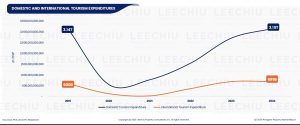
Presenting a comparison between domestic and international tourism expenditures, Lay noted that local travel continues to be the backbone of the Philippine tourism industry.
“The Philippines is a domestic tourism powerhouse,” he explained. “We have a large population that spends heavily on travel, providing a strong foundation for future growth in international tourism.”
He added that domestic tourism spending has already surpassed pre-pandemic levels with P3.15 trillion (as recorded in 2024), setting the stage for a broader recovery.
While foreign currencies have greater spending power, the strength of the domestic travel market has proven substantial—capable of offsetting shortfalls in international arrivals in the near term. Looking ahead, Lay projected that, “a feasible long-term objective would be to double the volume of domestic tourism within the next five to ten years.”
Tourism outpacing national growth
Lay pointed out that tourism’s share of the country ’s GDP currently sits around 9%, with projections aiming for 15–20% in the future — depending on how well the public and private sectors capitalize on available opportunities.
“It’s worth noting that tourism is currently growing faster than the overall economy,” Lay said, underscoring its potential as a key growth engine.

International Arrivals: Long-haul gains, regional hurdles
While acknowledging that international arrivals have not yet returned to 2019 levels — a trend consistent across much of Asia — Lay expressed optimism about long-haul markets.
“We’re seeing strong growth from the United States, Canada, and Australia — between 10% to nearly 20% increases,” he said. He credited the uptick to expanding flight connections, including new direct routes to Canada, the US, and a recent Air France route to Manila.
However, Lay also raised concerns about the South Korean market, which remains down by 19%. He attributed the decline to negative media coverage related to security incidents involving Korean nationals.
“Perception plays a big role. While security issues happen across Southeast Asia, we must manage how these are communicated abroad,” he stressed.
Hotel sector performance and affordability
On the hotel front, Lay reported that four- and five-star hotels across the Philippines are performing well — a reflection of post-pandemic travel trends favoring higher-end experiences. In contrast, budget hotels face pricing pressure and competition from unregulated Airbnb listings, especially in urban areas.
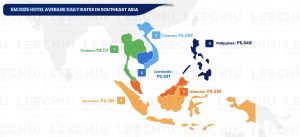
Responding to frequent criticism about the high cost of travel in the Philippines, Lay shared LPC’s comparative data showing that hotel rates in the country remain competitive relative to neighboring countries.
“We’re somewhere in the middle — or even the lower end — of Southeast Asia in terms of hotel pricing,” he clarified.
Transport costs and future prospects
Lay admitted that transportation costs remain high, largely due to the country’s archipelagic geography. However, Leechiu believes that growth in both domestic and international travel will allow airlines and infrastructure to scale, ultimately driving prices down over time.
“The solution lies in scale. As we grow, the costs of flying and moving around the country will come down,” he said.
Lay concluded, “We are still very price competitive across the region, and with continued investment and coordinated effort, the tourism sector will keep growing — and play a bigger role in the country’s economic future.”


