

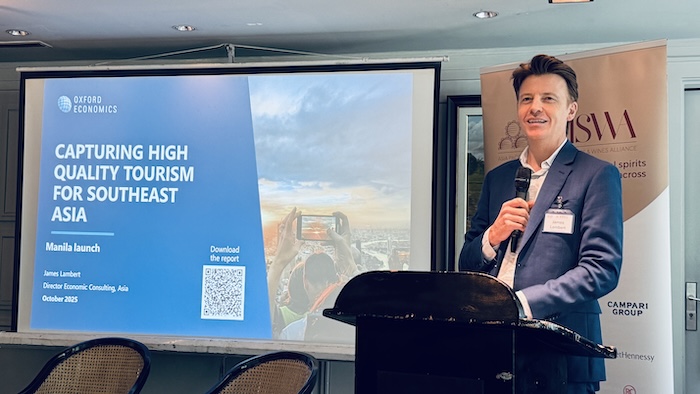
The Philippines has seen a remarkable rebound in tourism spending this year, with total inbound receipts surpassing pre-pandemic levels, according to Oxford Economics. However, the country’s total tourist arrivals have yet to fully catch up to 2019 numbers — a sign that while travelers are spending more, the country’s visitor volume remains in gradual recovery.
This insight was shared recently by James Lambert, Oxford Economics’ Director of Economic Consulting , during the presentation of the study “Capturing High Quality Tourism in Southeast Asia: The Impact of Premium F&B Experiences on Destination Choice.”
Oxford Economics analysts noted that the Philippines’ tourism recovery reflects a broader regional trend across Asia-Pacific, which has been slower to regain pre-pandemic momentum compared to other parts of the world. A key reason, they said, is the delayed return of outbound Chinese travel.
“Across the APAC region, recovery has been slower largely because of one big factor — Chinese outbound tourism,” said the analyst. “The domestic tourism scene in China has boomed, while international travel remains soft amid economic headwinds. For destinations like the Philippines, which previously enjoyed a large Chinese travel segment, that has had a bigger impact.”
Shift in traveler composition boosts spending
Despite fewer arrivals, the Philippines’ tourism value has grown significantly. Oxford’s analysis attributes this to changing visitor profiles — particularly the rising number of long-haul European tourists and the faster return of Korean travelers.
“There’s been a quicker pick-up in Korean inbound travel and strong growth from European markets,” the analyst added. “These travelers typically stay longer and spend more per trip than the average regional tourist.”
While this shift contributes to higher overall tourism receipts, the report clarifies that it may not yet signal a full structural upgrade of the country’s tourism value chain. Instead, the rise is driven by compositional factors — who’s coming in, rather than a fundamental change in the market.
Branding and competitiveness challenges
Compared to neighboring destinations like Singapore, the Philippines still faces an uphill battle in attracting and retaining high-value travelers.
Oxford report surveyed 1,800 travelers from five source markets — China, South Korea, Australia, the United States, and the United Kingdom — to determine what influences their choice of destination. The findings reveal that tourists are willing to spend $250 more per person per day to visit destinations that offer premium and memorable experiences.
“Average spend per trip in the Philippines remains lower than in competing destinations,” the analyst noted. “There’s still a perception and branding challenge. It’s a highly competitive environment for premium travelers, and neighboring countries have invested heavily to capture that market.”
Citing Singapore’s transformation over the past two decades — particularly with developments like Marina Bay — the report underscores how large-scale, strategic investments can reposition a destination for high-spending segments.
Quality and safety first
Oxford Economics also highlighted the importance of strong policy frameworks to sustain quality growth. The analyst stressed that while no government deliberately encourages unsafe practices, tourism policies should actively eliminate barriers to achieving higher safety and quality standards.
“It’s about ensuring that nothing stands in the way of quality and safety — whether that’s addressing issues like counterfeit alcohol or enforcing hygiene standards in the food sector,” the analyst explained.
He added that the Philippines could take inspiration from how other countries have elevated their culinary and hospitality reputation through systematic training, skills development, and quality control.
“Peru is a great example,” he shared. “It now has the world’s number one restaurant and a strong global culinary reputation. Two decades ago, that wasn’t the case. That transformation came from structured training and standardization — something the Philippines could consider for its own tourism assets.”
Looking ahead
Oxford Economics expects Chinese outbound travel to gradually return to pre-pandemic levels over the next year, which could reshape the region’s tourism dynamics once again. For the Philippines, the challenge will be to sustain the momentum — turning today’s compositional gains into a long-term, high-value tourism strategy built on quality, safety, and global competitiveness.


